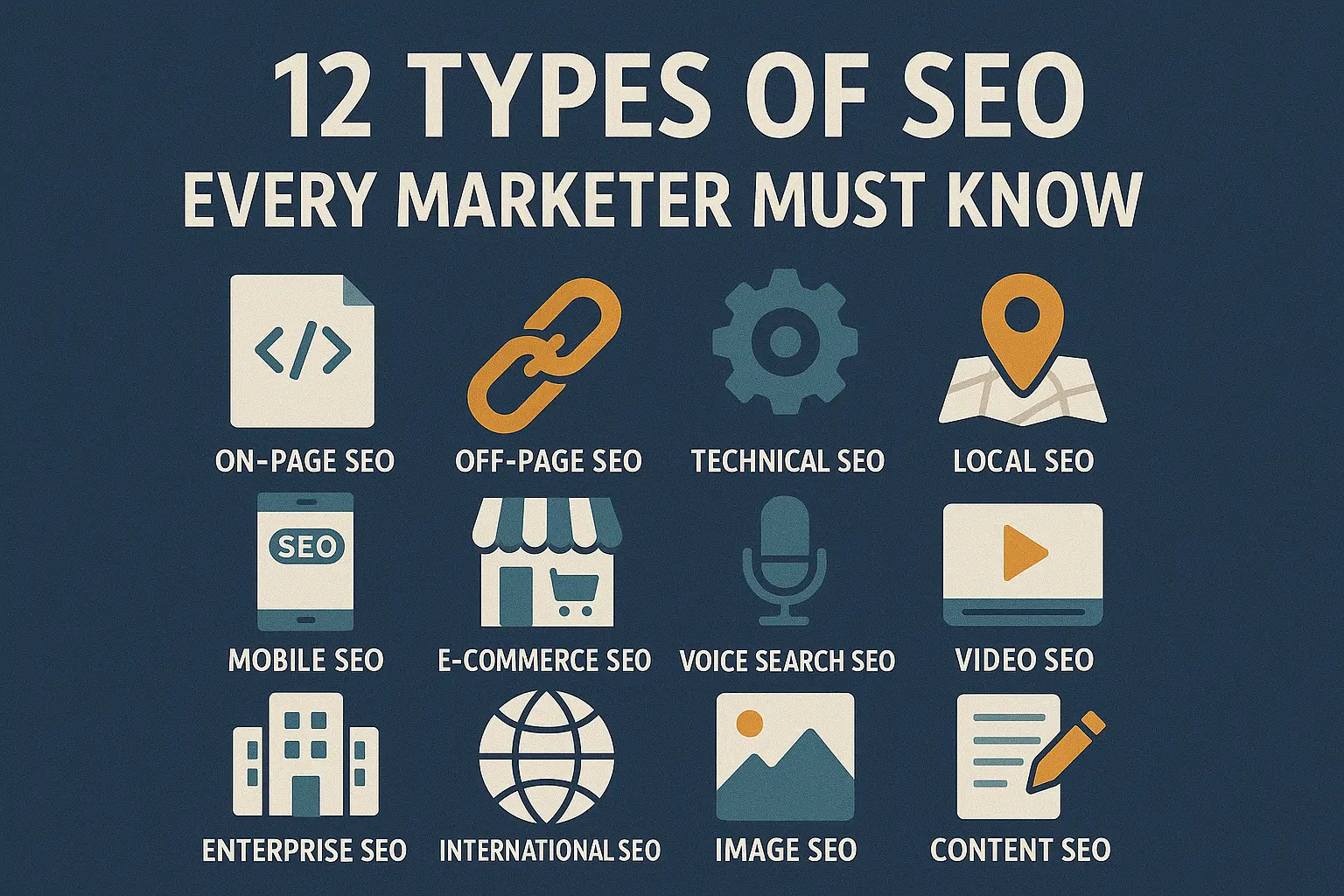
Discover the 12 essential types of SEO every marketer must master — from technical and local to voice and video SEO. This complete guide explains how each type works and how to integrate them into a winning digital strategyand beyond.
In the early days of digital marketing, SEO was a monolithic concept—get backlinks, stuff keywords, and hope to rank. Today, that approach is not just outdated; it’s dangerously simplistic. Modern SEO is a multifaceted discipline, a constellation of interconnected specializations that together form a comprehensive strategy for sustainable online visibility.
For marketers, understanding these distinct types of SEO is no longer optional—it’s a strategic imperative. It’s the difference between a fragile, one-tactic wonder and a resilient, all-weather visibility engine. This guide demystifies the 12 critical branches of SEO, providing you with the knowledge to build a holistic, future-proof strategy.
The 12 Pillars of a Holistic SEO Strategy
1. Technical SEO: The Foundation of All Visibility
Technical SEO is the behind-the-scenes infrastructure that allows search engines to crawl, index, and understand your website. It’s the bedrock—if it’s flawed, everything built on top is unstable.
- Core Focus: Website speed, mobile-friendliness, site architecture, crawlability, indexation, structured data (schema markup), and security (HTTPS).
- Key Tools: Google Search Console, Screaming Frog, PageSpeed Insights, DeepCrawl.
- Why Marketers Must Know It: You can create the world’s best content, but if technical errors block Googlebot, it’s invisible. Marketers must advocate for technical health and understand its impact on performance metrics.
2. On-Page SEO: The Art of Page-Level Optimization
This is the optimization of individual web pages to rank higher and earn more relevant traffic. It’s where content meets keyword intent.
- Core Focus: Title tags, meta descriptions, header tags (H1, H2, H3), keyword placement, content quality and depth, internal linking, image optimization (file names & alt text), and URL structure.
- Key Concept: E-E-A-T (Experience, Expertise, Authoritativeness, Trustworthiness). Google rewards content that demonstrates these qualities.
- Why Marketers Must Know It: Content and marketing teams directly control on-page elements. This is where your messaging and SEO strategy converge.
3. Off-Page SEO: Building Authority and Trust
Off-page SEO refers to actions taken outside your own website to impact rankings, primarily through earning backlinks and digital mentions. It’s your site’s reputation in the wider web ecosystem.
- Core Focus: Link building (guest posts, PR, digital PR, resource links), brand mentions, social signals, and influencer partnerships.
- Key Metric: Domain Authority/Rating – a measure of your site’s perceived strength based on its backlink profile.
- Why Marketers Must Know It: PR, partnerships, and content amplification campaigns are inherently off-page SEO activities. Marketers must design campaigns that earn authoritative links, not just social shares.
4. Local SEO: Winning the "Near Me" Battleground
Local SEO optimizes your online presence to attract customers from local searches on Google, Bing, and maps. Critical for brick-and-mortar businesses and service areas.
- Core Focus: Google Business Profile (GBP) optimization, local keyword targeting, NAP (Name, Address, Phone) consistency across directories, local citations, and geo-tagged content.
- Key Tool: Google Business Profile. Your virtual storefront on search and maps.
- Why Marketers Must Know It: For any business with a physical location, local SEO drives foot traffic and high-intent calls. It integrates with event marketing and community engagement.
5. National/International SEO: Scaling Visibility
This involves optimizing a website to rank across a country or multiple countries. It deals with geo-targeting, language, and cultural nuances.
- Core Focus: Country-specific top-level domains (ccTLDs like .uk, .ca), hreflang tags for multilingual sites, server location, and content localization (not just translation).
- Key Challenge: Managing geo-targeting settings in Google Search Console and creating truly resonant content for each locale.
- Why Marketers Must Know It: Market expansion strategies are SEO strategies. Entering a new region requires a planned SEO approach to domain structure and content.
6. Content SEO: The Strategic Layer of Creation
Content SEO moves beyond on-page tweaks to the strategic planning, creation, and promotion of content designed to rank for specific user intents and stages of the buyer journey.
- Core Focus: Topic clustering, keyword intent mapping, content gap analysis, pillar page creation, and aligning content with the sales funnel.
- Key Framework: The Topic Cluster Model – one pillar page (broad topic) supported by many cluster posts (subtopics) linked together.
- Why Marketers Must Know It: Content marketing is content SEO. Every blog, guide, or video should be created with a clear SEO goal—answering a question, solving a problem, and capturing intent.
7. E-commerce SEO: Optimizing the Digital Shelf
The specialized SEO for online stores, focusing on product pages, category pages, and a unique set of challenges like duplicate content (from product variants) and thin content.
- Core Focus: Product page optimization (unique descriptions, high-quality images, reviews), category page content, site search optimization, managing faceted navigation, and implementing product schema markup for rich results.
- Key Tactic: Creating unique, valuable content beyond manufacturer product descriptions to overcome thin content issues.
- Why Marketers Must Know It: Directly impacts product discoverability and conversion. Integrates with paid shopping campaigns and inventory management.
8. Voice SEO: Optimizing for Conversational Queries
Optimizing content to appear as a result for voice searches via assistants like Siri, Alexa, and Google Assistant. Voice queries are typically longer and more conversational.
- Core Focus: Targeting question-based keywords ("how to," "what is," "best way to"), using natural language, securing Featured Snippets (Position Zero), and providing concise, direct answers.
- Key Difference: Optimizing for sentence-long queries vs. short-tail keywords.
- Why Marketers Must Know It: Voice search is fundamental to the rise of ambient computing. Brands that answer questions conversationally will own this growing touchpoint.
9. Video SEO: Ranking on the Second Largest Search Engine
Optimizing video content to rank in both traditional search results (Google) and on platforms like YouTube, which functions as the world’s second-largest search engine.
- Core Focus: Keyword research for video, compelling titles/descriptions, custom thumbnails, video transcripts, engagement signals (watch time, likes), and video schema markup.
- Key Platform: YouTube SEO – utilizing playlists, chapters, and community tabs.
- Why Marketers Must Know It: Video is a dominant content format. SEO principles ensure your video assets are discoverable, extending your reach beyond your website.
10. Mobile SEO: The First-Priority Experience
Optimizing your website specifically for mobile users. Since Google’s move to mobile-first indexing, your mobile site is the primary version Google uses for ranking.
- Core Focus: Responsive design, mobile page speed, tap-friendly elements, avoiding intrusive interstitials (pop-ups), and ensuring content parity between mobile and desktop.
- Key Metric: Core Web Vitals (LCP, FID, CLS) – Google’s user experience metrics.
- Why Marketers Must Know It: The vast majority of searches happen on mobile. A poor mobile experience destroys conversion rates and brand perception, regardless of your ranking.
11. Enterprise SEO: Managing Complexity at Scale
The practice of SEO for large, complex websites (often with thousands or millions of pages, multiple subdomains, and international teams). It focuses on governance, processes, and mitigating large-scale risks.
- Core Focus: Crawl budget optimization, information architecture for massive sites, international/regional SEO strategy, cross-team SEO governance, and advanced analytics.
- Key Challenge: Aligning multiple departments (IT, content, regional teams) under a unified SEO strategy.
- Why Marketers Must Know It: For marketers in large organizations, success depends on navigating complexity, securing buy-in, and implementing scalable processes, not just tactical optimizations.
12. Sustainable/Ethical SEO (White Hat SEO)
The practice of following search engine guidelines to build long-term organic visibility. It’s the commitment to strategies that focus on the human user, not just manipulating algorithms.
- Core Focus: Creating genuine value, earning links naturally, ensuring accessibility, focusing on user experience, and avoiding forbidden tactics (link schemes, cloaking, hidden text).
- Key Philosophy: Build for users, optimize for engines. The algorithms are increasingly designed to reward this very approach.
- Why Marketers Must Know It: Brand reputation and sustainability. Black-hat tactics lead to penalties and erased visibility. Ethical SEO is the only strategy that aligns with long-term brand building and trust.
The Synergy: How The 12 Types Work Together
True SEO mastery lies in integration. A local bakery needs Technical SEO (a fast site), Local SEO (optimized GBP), On-Page SEO (great content about its cakes), Content SEO (a blog on "best birthday cakes in [city]"), and Mobile SEO (easy browsing on phones). An e-commerce giant needs robust Enterprise and Technical SEO foundations to support its E-commerce and International efforts.
The Marketer’s Action Framework:
- Audit & Diagnose: Map your current efforts against these 12 pillars. Where are you strong? Where are you absent?
- Prioritize: Not all types are equally important for every business. A SaaS company may prioritize Content, Technical, and Off-Page, while a restaurant chain focuses on Local, Mobile, and On-Page.
- Integrate: Break down silos. Ensure your content team understands On-Page and Voice SEO. Ensure your PR team understands Off-Page SEO. Ensure your developers are briefed on Technical and Mobile SEO.
- Measure Holistically: Look beyond "rankings for X keyword." Measure organic traffic growth, featured snippet ownership, local map pack visibility, video watch time, and, ultimately, conversion from each SEO channel.
Conclusion:
The 12 types of SEO represent a fundamental truth: search optimization is woven into every aspect of digital presence. It is not a standalone task for a specialist but a core business function that touches technology, content, public relations, user experience, and international strategy.
For the modern marketer, this knowledge is power. It’s the power to communicate needs to developers, brief content creators with precision, design link-worthy campaigns, and build a brand that is not just found, but sought after. In the crowded digital landscape, those who understand the full spectrum of SEO won’t just play the game—they’ll define it.