Discover how AI Search (SGE) is transforming traditional SEO audits. Learn how generative search changes ranking signals, semantic SEO, authority, and audit strategies.
Search is experiencing a once-in-a-generation transformation. For more than two decades, SEO professionals optimized for a familiar model: crawl → index → rank → click. But Google’s Search Generative Experience (SGE) introduces a new search reality — one where AI doesn’t just rank web pages, but reads, interprets, summarizes, and responds to user queries in real time.
This shift is not just an algorithm update.
It is a complete redesign of how search engines evaluate information and how users interact with results.
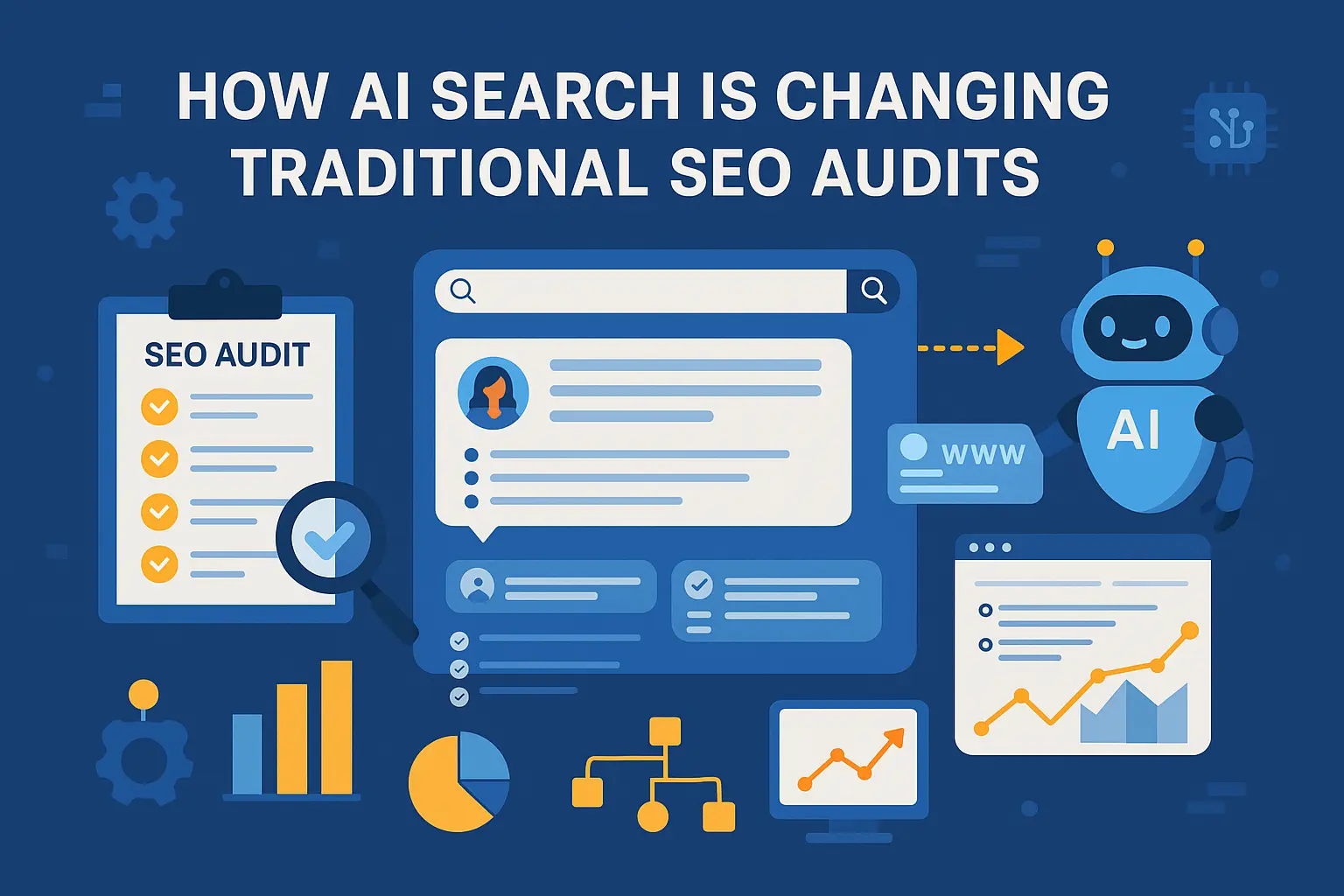
Traditional SEO audits—focused on technical factors, keywords, meta tags, and backlinks—are no longer enough. A new audit framework is emerging, one that evaluates semantic relevance, topical authority, extractability of information, and “AI-readiness.”
This article blends both practical SEO guidance and advanced strategic insights to explain how SGE is changing SEO audits — and how businesses must adapt to stay visible in the AI era.
What Is AI Search (SGE)?
AI Search—specifically Google’s Search Generative Experience—turns a simple search query into a conversational, contextual experience powered by generative AI.
Instead of returning a list of links (“10 blue links”), SGE:
- Reads and synthesizes information from multiple sites
- Generates a summary answer in real time
- Suggests follow-up questions
- Provides interactive and dynamic responses
- Gives cited sources for deeper exploration
Imagine a search engine that behaves more like a highly knowledgeable personal assistant. It doesn’t just fetch pages — it thinks, summarizes, and guides the user through a complete information journey.
What an SGE Result Looks Like
An SGE result usually contains:
1. AI Snapshot
A highlighted generative summary answering the query.
2. Source Citations
Links to websites used to generate the answer.
3. Conversational Prompts
Suggested follow-up questions that retain context.
4. Vertical Integration
Shopping, videos, local info, or product comparisons directly in the summary.
This means users may satisfy their intent without clicking any website, drastically changing how SEO traffic flows.
Why SGE Is More Than an Algorithm Shift
SGE is not merely ranking pages differently — it is redefining:
- How Google interprets content
- How answers are assembled
- How users consume information
- How visibility is assigned
- How authority is determined
Unlike traditional search, SGE:
- Synthesizes new answers (not just retrieves pages)
- Maintains multi-step conversational context
- Understands semantic relationships
- Prioritizes comprehensive, trusted sources
- Reduces reliance on keyword matching
This “answer-first” model changes the very foundation of SEO audits.
The Collapse of Traditional SEO Audit Pillars
Keywords → Semantic Meaning
Old SEO audits focused heavily on:
- Keyword density
- Exact match phrases
- Keyword difficulty
- Search volume
SGE focuses on:
- Topic coverage
- Semantic depth
- Related entities
- Context and comprehension
- Ability to answer conversational queries
Keyword targeting still matters, but intent > keywords now.
Backlinks → Source Authority in AI Summaries
Backlinks aren’t disappearing, but their role is shifting.
SGE prioritizes:
- Whether your site is trustworthy enough to cite
- Expertise demonstrated in the content
- Cross-platform authority (not just links)
- Recency and relevance
Being a cited source in SGE is the new measure of authority.
Technical SEO → AI-Accessible Technical SEO
Traditional audits check:
- Crawling
- Indexing
- Sitemaps
- Speed
- Redirects
Now technical SEO also includes:
- Structured data for entity recognition
- Content chunking for AI extraction
- Multi-format compatibility (text, video, tables)
- Real-time data availability
Technical SEO is evolving from “make pages crawlable” to “make content understandable and usable by AI.”
How SGE Interprets Content Differently
SGE doesn’t evaluate content like a human reader — it analyzes:
- Entities
- Semantic relationships
- Context structure
- Information density
- Definitive statements
- Step-by-step processes
- Summaries and key points
It favors content that is:
✔ Easy to extract
✔ Easy to summarize
✔ Organized logically
✔ Rich with context
✔ Supportive of user intent
This means content must be optimized for both humans and AI systems.
The New SEO Audit Framework for the SGE Era
Here is the combined, refined, and modernized audit checklist:
Content Architecture & Semantic Optimization
Topic Coverage Audit
Do you cover the entire subject area, not just individual keywords?
Gap Analysis Against SGE Answers
Compare SGE snapshots with your existing content — what is missing?
Semantic Relevance Review
Evaluate:
- Entities
- Relationships
- Context consistency
- Natural language patterns
Conversational Query Audit
Does your content answer follow-up questions users may ask?
SGE Visibility & Brand Presence Audit
Citation Frequency in AI Answers
Are you being cited? If not, why?
SGE Position Analysis
Check whether your content appears:
- At the start of SGE
- In supporting links
- As a deep source further down
Competitor SGE Analysis
Which competitors dominate generative answers?
Zero-Click Optimization
Ensure your content provides value even if users don’t click.
Technical Infrastructure for AI Search
Structured Data Enhancement
Ensure:
- Article
- FAQ
- HowTo
- Breadcrumb
- Organization
- Product (if applicable)
Schema helps AI understand your content.
Entity Mapping
Your brand, authors, and topics must be clearly recognized.
Content Chunking
Break information into logical, extractable blocks:
- Lists
- Tables
- Highlights
- Key takeaways
Multi-Format Alignment
Ensure consistency across:
- Text
- Videos
- Infographics
- Tools
- Downloads
Real-Time & Freshness Signals
SGE favors updated and time-sensitive content.
The New SEO KPIs in the SGE World
Traffic and rankings still matter, but new metrics emerge:
✔ SGE impressions
How often your brand appears inside AI-generated answers.
✔ Citation share
Percentage of SGE queries where you are referenced.
✔ Answer depth
How prominently your content appears inside the AI snapshot.
✔ Follow-through rate
Do users click your link AFTER reading the AI answer?
✔ Brand recognition
Are you becoming an “authority entity” in your niche?
Industry-Specific SGE Audits
E-Commerce
- Feature extraction
- Product comparison readiness
- Schema for reviews, availability, price
Local SEO
- Local business schema
- Google Business Profile data accuracy
- Real-time availability
B2B Services
- Expertise-driven content
- Case studies
- Methodology transparency
The Human Factor: More Important Than Ever
AI elevates the importance of:
- First-hand experience
- Original research
- Expert authorship
- Unique viewpoints
- Transparent processes
SGE rewards websites that contribute new value, not those that rephrase existing content.
The Roadmap: How to Transition Your SEO Audits
Next 30 Days
- Analyze SGE results for your niche
- Identify missing entities
- Update structured data
- Improve content extractability
Next 3–6 Months
- Build topic clusters
- Establish author authority
- Create experience-based content
Next 12 Months
- Develop proprietary data
- Become a cited source in your industry
- Build AI-optimized content systems
Conclusion: The Future of SEO Belongs to AI-Optimized Authority
The rise of SGE doesn’t kill SEO — it evolves it.
Traditional audits focusing on technical fixes and keyword checks are no longer enough. To succeed, websites must become:
- Semantically rich
- Authoritative
- Trustworthy
- AI-readable
- Extractable
- Experience-driven
In the AI era, rankings matter less than becoming the source AI chooses to cite.
Websites that embrace this new audit mindset will dominate the future of search.