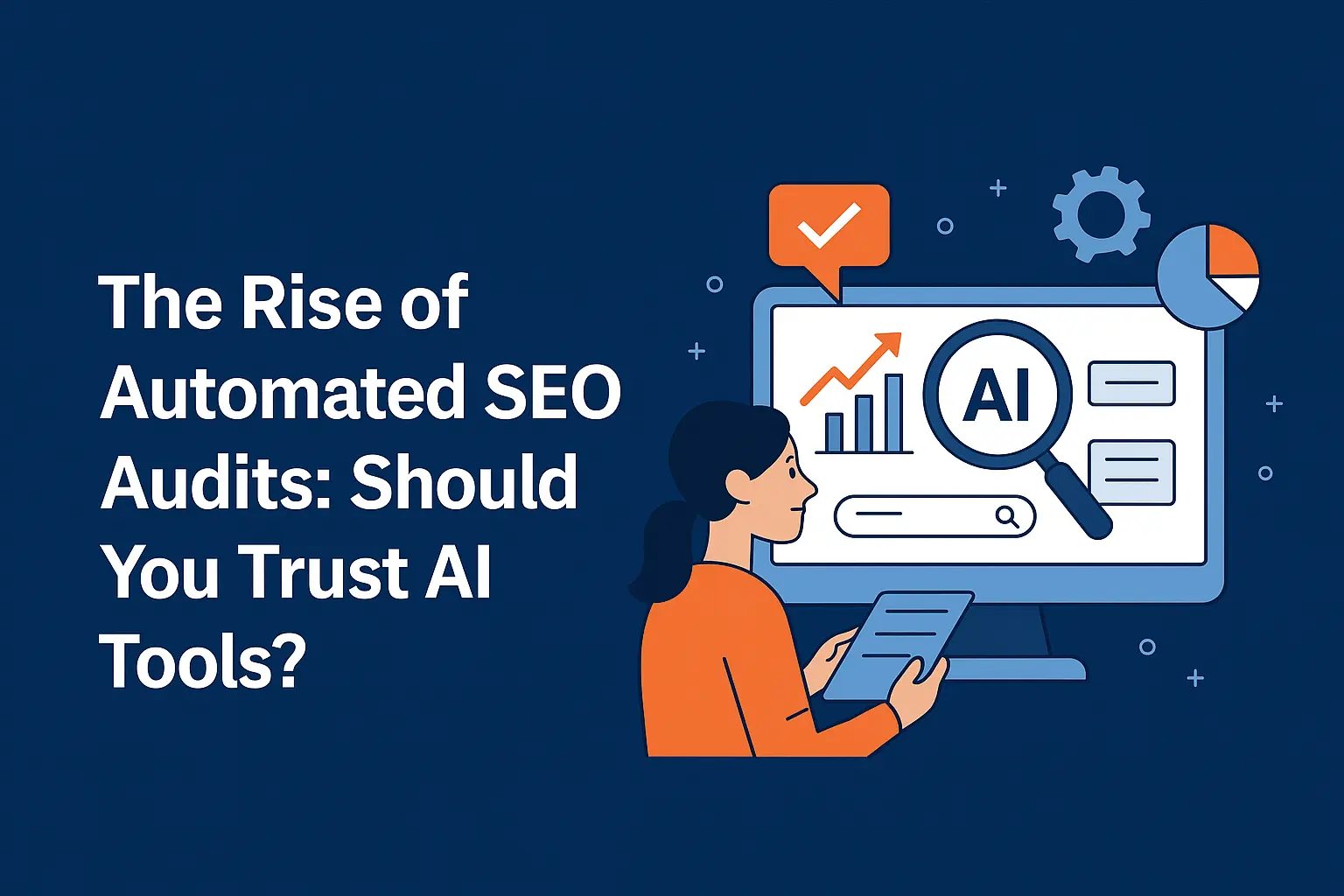
Explore how AI-powered SEO audits are transforming website optimization. Learn their benefits, limitations, and whether automated tools can truly be trusted.
The world of SEO has changed dramatically over the last few years. Businesses no longer rely solely on manual analysis, spreadsheets, or time-consuming audits performed by SEO specialists. Instead, automated SEO audit tools powered by artificial intelligence have taken center stage — promising faster results, deeper insights, and smarter optimization recommendations.
But with this rapid rise comes an important question:
Should you fully trust AI tools for SEO audits?
Are they reliable enough, or do they miss the nuance that only human experts can understand?
This article explores the evolution, strengths, limitations, and future of automated SEO audits — helping you decide how much trust you should put into AI-powered tools.
🚀 1. What Are Automated SEO Audits?
An automated SEO audit is a machine-driven analysis of your website’s performance, structure, technical health, and ranking opportunities. Instead of manually checking hundreds of parameters, a tool scans your site and generates a detailed report within seconds.
Automated audits usually analyze:
- Technical SEO issues
- Page speed & Core Web Vitals
- On-page optimization
- Backlinks and authority
- Content quality
- Structured data
- Mobile performance
- Indexing and crawlability
And because these audits run using AI and automation, they provide:
- Instant results
- Error detection at scale
- Data-backed recommendations
- Consistent reporting
No human can check a 5,000-page website in minutes — but a machine can.
2. Why AI Tools Are Becoming So Popular in SEO
It’s not just speed; AI tools bring multiple advantages.
2.1 Speed and Efficiency
Traditional SEO audits may take hours or days.
AI-driven tools finish them in seconds to minutes.
2.2 Accuracy Through Pattern Detection
AI can detect issues based on huge datasets and patterns from millions of websites.
2.3 Real-Time Monitoring
Most advanced tools run continuous audits, alerting you to new issues instantly.
2.4 Valuable Suggestions Based on Data
AI tools don’t just identify problems — they recommend solutions.
2.5 Cost-Effective
Automated audits reduce the need for hiring multiple professionals, making them ideal for:
- Small businesses
- Agencies
- Bloggers
- E-commerce stores
- Developers
These benefits explain why automated SEO audits are rising globally.
3. But Should You Fully Trust AI Tools? The Honest Truth
AI tools are powerful — but not perfect.
There are specific areas where they fall short, and relying 100% on automation can lead to mistakes.
Let's break down the concerns.
4. What AI SEO Tools Do Really Well
4.1 Technical Error Detection
AI tools excel at identifying:
- Broken links (404 errors)
- Redirect loops
- Missing alt text
- Slow-loading pages
- Mobile usability errors
- Duplicate pages
- Missing meta tags
They scan your entire site systematically and rarely miss technical flaws.
4.2 Speed Testing & Core Web Vitals
AI offers precise measurements for:
- LCP
- CLS
- INP
- TTFB
These metrics are essential for ranking in modern search engines.
4.3 Keyword & Competitor Analysis
AI can calculate:
- Keyword difficulty
- Search volume
- SERP trends
- Competitor gaps
It does this faster and often more accurately than humans.
4.4 Content Scoring & Optimization
AI tools evaluate:
- Readability
- Keyword density
- NLP signals
- Semantic depth
They show you what’s missing and what you should improve.
5. What AI Tools Cannot Do (Yet)
Despite their strengths, AI tools struggle with things that require context, creativity, and human judgement.
5.1 Understanding Search Intent Deeply
AI may suggest keywords that don’t match what users truly want.
5.2 Judging Content Quality Beyond Metrics
A machine cannot fully understand:
- Emotion
- Storytelling
- Authority
- Expertise
- Human trust
Google's E-E-A-T signals depend greatly on human-verified authority.
5.3 Overlooking Nuanced Technical Issues
Some issues require:
- Manual inspection
- Code review
- Server analysis
- Real-world user testing
AI doesn’t always catch these subtle errors.
5.4 Recommending Nuanced SEO Strategies
AI tools provide general suggestions, but only humans can create:
- Tailored SEO strategies
- Niche-specific approaches
- Brand-aligned content plans
5.5 Relying Too Much on Automation Can Be Dangerous
If you never review AI recommendations manually, you may:
- Over-optimize pages
- Use incorrect keywords
- Follow inaccurate suggestions
- Miss high-value opportunities
So while AI is powerful, it should be treated as a support tool, not a replacement for human strategy.
6. Should You Trust Automated SEO Audits? (Balanced Answer)
The short answer:
Yes — but only partially.
The longer answer:
✔️ Trust AI for:
- Technical SEO detection
- Speed metrics
- Crawlability checks
- Duplicate content detection
- Structured data validation
- Quick site-wide scans
✔️ Do NOT trust AI alone for:
- Complex SEO strategy
- Content expertise
- Audience analysis
- Creative optimization
- Competitor positioning
- Brand-aligned SEO decisions
AI tools are excellent diagnostic tools, but they are not SEO strategists.
The ideal solution is human + AI collaboration.
7. The Future of Automated SEO Audits
AI is evolving fast.
In the next few years, expect:
🚀 AI that understands search intent
🚀 AI that generates strategic recommendations
🚀 Fully automated SEO monitoring systems
🚀 Predictive ranking models
🚀 Voice-search-based audit systems
🚀 AI that integrates with analytics for deeper insights
But even in the future, human oversight will still matter.
8. How to Use AI SEO Tools the Right Way
Here’s the correct approach:
Step 1: Run an AI-powered audit
Get a list of errors and improvement opportunities.
Step 2: Review the findings manually
Filter out incorrect or irrelevant suggestions.
Step 3: Apply human SEO strategy
Use expertise, experience, and audience insights.
Step 4: Re-run audits regularly
AI tools are great for monitoring ongoing changes.
Step 5: Combine multiple tools
No single tool is perfect. Use a mix for best results.
Final Verdict: Are AI Tools Worth It?
Absolutely — AI-powered SEO audits save time, reduce cost, and dramatically improve accuracy.
But should you trust them blindly?